Find online casinos in Australia that accept both Visa and Apple Pay. Compare transaction limits, settlement speeds, and security for both payment methods.
Pairing Apple Pay with Visa is the standard hybrid setup on most Apple Pay casino sites in AU, because the wallet inherits the BIN's withdrawal ceiling and the card carries the higher transaction limits. While Apple Pay simplifies mobile deposits, Visa remains a staple for larger transactions and bank-led settlement. Below, the Visa cross Apple Pay casino platforms that support both methods are surfaced, ensuring flexibility for various bankroll needs. In our review, most top-rated operators here processed AUD without hidden conversion fees. By understanding how these two systems interact, players can optimize their cash flow and transaction security.
01
Jeetcity Casino
4.8
Wallet-friendly cashier where PayID, Visa and Neosurf are joined by ten-plus crypto currencies
Fast banking out: PayID and coin payouts complete inside 24 hours of approval
Slots and live games top 6,000 in total, with Hacksaw Gaming, Nolimit City and Evolution on the roster
Welcome bonus
100% up to A$7,500 + 100 FS!
Curaçao (GCB)—A$30 min deposit—0–24h crypto/PayID withdrawal—6,000+ games
Solving the Payment Gap: Why Apple Pay Casino Users Also Need Visa
Many players want the speed of digital wallets paired with the high limits of credit or debit cards. Visa often allows larger single transactions compared to some mobile wallet caps, which can be restrictive for high-rollers or those managing larger bankrolls. For instance, while Apple Pay may cap individual deposits at a few hundred dollars, a Visa card frequently supports thousands in a single session. This Visa cross Apple Pay casino flexibility ensures that players can scale their activity without being forced to perform multiple smaller transactions.
Beyond transaction limits, the option to switch between these methods provides a critical fallback mechanism. If a mobile wallet service experiences temporary downtime, a direct Visa card transaction ensures access to funds. Conversely, when quick, low-stakes deposits are needed, Apple Pay offers a friction-free experience. Having both options available on a single platform reduces reliance on any one financial rail and enhances overall account accessibility.
Moreover, Visa's widespread acceptance across Australian banking institutions means that players can link their preferred bank account with familiar security protocols. This familiar environment, combined with the modern convenience of Apple Pay, creates a balanced payment ecosystem. Operators that integrate both methods cater to a broader range of player preferences, from security-conscious traditionalists to tech-forward mobile users.
Understanding Visa in the Apple Pay Casino Ecosystem
Visa is a primary payment rail used by most banks across Australia, supporting both debit and credit options. It operates as a settlement network rather than issuing cards directly, meaning the underlying bank determines the specific terms of use. This structure allows for high interoperability across different casino platforms. When a player uses a Visa card, the transaction is routed through the Visa network to the issuing bank for authorization.
In the context of Apple Pay Casino real money platforms, Visa serves as a foundational layer that many mobile wallets rely upon. The card added to the Apple Wallet often has a Visa logo, meaning the underlying transaction still passes through the Visa network. This dual-layer approach combines the biometric encryption of Apple Pay with the global settlement infrastructure of Visa.
For Australian players, this means that even when using a digital wallet, the protections associated with Visa, such as fraud monitoring and dispute resolution, are typically still active. The core benefits of Visa — including widespread acceptance, reliable security standards, and predictable fee structures — remain intact whether the card is used directly or via a mobile wallet interface.
Top-Rated Platforms Supporting Both Visa and Apple Pay
These operators have implemented dual-payment systems to accommodate both digital wallet and card users. The ranking includes platforms with verified AUD processing and clear transaction limits.
The comparison table above highlights key differences in limits and processing times. Players should review the specific terms of each platform to ensure they align with their preferred banking habits.
Direct Comparison: Apple Pay vs. Visa for Online Deposits
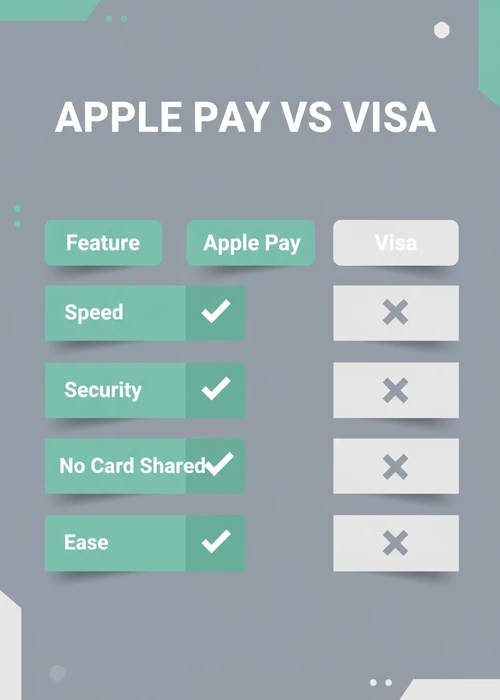
Comparing these methods reveals significant differences in settlement speed and maximum transaction amounts. Apple Pay typically offers instant deposits, whereas Visa may require longer processing times for withdrawals. The choice between them often depends on whether immediate access or higher limits are more important for a given session.
Feature
Apple Pay
Visa Card
Typical Deposit Limit
Withdrawal Time
Primary Benefit
Apple Pay
Instant
AUD
Up to $500
0-24 hours
Mobile speed
Visa Debit
1-5 minutes
AUD
Up to $2,000
1-3 business days
Broad acceptance
Visa Credit
1-5 minutes
AUD
Up to $5,000+
1-3 business days
Higher limits
Fee Structure
Usually zero
May vary
Operator-dependent
Bank-dependent
Transparency
Security
Biometric
Chip & PIN
Standard encryption
Fraud monitoring
Layered protection
The table underscores that Apple Pay excels in deposit speed and mobile-first transactions, while Visa provides substantial headroom for larger movements of funds. Players should consider these factors when planning their deposits and choosing the right method for their needs.
Transaction Processing Speeds
Apple Pay deposits are usually processed instantly, enabling immediate play without the need to wait for bank confirmation. This makes it the preferred choice for players who want to access their funds quickly and without interruption. Visa transactions can also be processed quickly, but withdrawals may take 1-3 business days to reach your bank account, depending on the operator's internal processing times and bank settlement cycles.
Deposit and Withdrawal Limits
Apple Pay often has lower limits, typically around $500 per transaction, which can be restrictive for high-value players. In contrast, Visa cards can support significantly higher limits, sometimes exceeding $5,000 depending on the operator policies and your bank's settings. This difference makes Visa the more suitable option for players who intend to make larger deposits or withdraw substantial winnings in fewer transactions.
The Bonus-Eligibility Difference Between Direct Visa and Apple Pay
The Apple-Pay-vs-Visa choice on the deposit screen is usually framed around speed and limits, but bonus eligibility is the more decisive axis on a first-time qualifying deposit. Most offshore operators classify a direct Visa deposit as "card" (bonus-eligible by default) and a small but non-trivial subset classify Apple Pay as "digital wallet" (excluded from card-tier bonuses).
Deposit Path
How the Operator's Processor Logs It
Bonus Eligibility (Typical)
Visa card direct entry (PAN on form)
Standard card transaction, Visa MCC
Eligible for card-tier bonuses
Visa via Apple Pay (DAN routing)
Card transaction with digital-wallet descriptor
Eligible at most operators; excluded at a minority
Mastercard via Apple Pay (DAN routing)
Card transaction with digital-wallet descriptor
Same pattern as Visa-via-Apple-Pay
Pure e-wallet (Skrill, Neteller, etc.)
E-wallet transaction
Routinely excluded from welcome bonuses
The practical decision rule for this situation: on a first bonus-qualifying deposit, read the promotion-specific "Excluded Payment Methods" clause. If Apple Pay is named, deposit via direct Visa or Mastercard once to unlock the bonus, then switch to Apple Pay for subsequent reload deposits where the underlying card account is the same but the speed and CDCVM verification are stronger. The strategic migration sections elsewhere on this page apply this rule in reverse — Visa for bonus capture, Apple Pay for ongoing session cadence.
When to Use Which: Strategic Migration Scenarios
Smart bankroll management involves choosing the method that suits the transaction size and urgency. Switching between Apple Pay and Visa can optimize your cash flow and ensure that you are always using the most efficient tool for the job.
When to Prioritise Apple Pay
Choose Apple Pay for fast, small-to-medium deposits and when mobile security is a priority. It is ideal for players who prefer biometric authentication and immediate funding. This method is perfect for quick sessions with modest stakes, as it streamlines the deposit process and minimizes friction.
When to Opt for Visa Transactions
Visa is best for larger deposits or withdrawals that exceed mobile wallet limits. It provides a reliable option for players who prefer traditional card processing and higher transaction ceilings. Use this method when managing a significant bankroll or when you need to move larger sums of money back to your bank account.
Handling Backup Scenarios
If your preferred method is temporarily unavailable, having both options allows you to switch smoothly. For example, if a Visa card payment is declined due to a temporary bank lock, Apple Pay can serve as a quick alternative. This redundancy prevents interruptions to gameplay and ensures continuous access to your funds.
Managing Budgetary Controls
Use Apple Pay for daily sessions to maintain tight control over your spending, leveraging its lower limits as a natural budget. For monthly funding or large withdrawals, switch to Visa. This approach helps separate routine play from major financial movements, enhancing overall bankroll discipline.
By strategically alternating between these two methods, players can maximize both convenience and control. This flexibility is a key advantage for those who actively manage their online gaming budget.
Avoiding Common Pitfalls When Switching Payment Methods
Some platforms require you to withdraw funds using the same method used for deposits. Switching midway can trigger additional KYC checks or delays, especially if a new payment method is introduced to the account. For example, depositing with Apple Pay and requesting a withdrawal via a direct Visa transfer may lead to a manual review process. This can extend the typical payout timeframe by several days.
Another common issue arises when players attempt to use a Visa card that is not enabled for international or online transactions. This can result in multiple declined payments and potential account flags. It is advisable to confirm with your bank that your card is unlocked for these types of purchases before attempting a deposit. Ensuring your card settings are correct from the start prevents unnecessary frustration and potential delays.
Additionally, players should be aware of potential currency conversion fees when using a non-AUD Visa card. While many casinos process in AUD, the issuing bank may apply its own exchange rate and a separate fee. This can subtly erode your bankroll over time. To avoid this, consider using a card or wallet specifically designed for multi-currency transactions or one that supports AUD natively.
Bank-Level Gambling Blocks: Why a Visa Works Where Apple Pay Fails (and Vice Versa)
The most common cause of an "Apple Pay declined, Visa accepted" outcome is not a wallet failure but a divergence in how AU issuers apply their gambling controls to the underlying card account versus the Apple Wallet token. Several banks evaluate the merchant category code identically in both paths, but a small number apply additional friction to tokenised credentials on first use against a gambling-coded merchant. The reverse case — Visa direct declined, Apple Pay accepted — occurs when the bank has flagged the raw PAN after multiple gambling debits and the player has not yet exhausted the daily limit on the tokenised credential. For players who would rather block all gambling spend at the source, registering with the national self-exclusion scheme sets clear expectations of what to expect once an exclusion is active.
Bank
Block Applies to Raw Card PAN
Block Applies to Apple Pay Token
Toggle Path
Direct Contact
Commonwealth Bank (CBA)
Yes
Yes (same control)
NetBank app, Card Controls
13 2221
NAB
Yes
Yes (same control)
NAB app, manage card
13 22 65
Westpac
Yes
Yes (same control)
Westpac app, Gambling Block
132 032
ANZ
Yes
Yes (same control)
ANZ app, Card Controls
13 13 14
ING
Optional
Optional (typically off)
Customer Service
133 464
Bendigo
Yes
Yes (same control)
Bendigo Bank app
1300 236 344
Macquarie
Optional
Optional (same control)
Macquarie Mobile Banking
133 174
Up Bank
Optional
Optional (same control)
Up app, Gambling Block
In-app chat
Revolut AU
Yes (default on)
Yes (same control)
Revolut app, Security
In-app chat
For the major four issuers, the block is implemented at the card-account level and applies identically to the PAN and the wallet token; "switching to Visa direct" will not resolve a CBA, NAB, Westpac, or ANZ gambling decline. The fastest fix is the in-app toggle plus, where applicable, waiting out the cooling period; the slowest is a written request to the bank's fraud team. The fastest cross-method workaround is adding an eligible card from a different issuer (e.g. ING) to the Apple Wallet rather than re-trying the same card in a different payment form factor.
Transaction Limits and Speed: A Practical Breakdown
Apple Pay deposits are instantaneous, while Visa withdrawals can take 1-3 business days. Maximum daily limits vary significantly by bank and operator, but understanding these benchmarks helps in planning your financial activity. Typically, Apple Pay facilitates smaller, quicker deposits, whereas Visa is suited for larger sums. For example, a typical daily deposit via Apple Pay might be capped at $1,000, while a Visa card could allow upwards of $5,000 per day.
Withdrawal speeds also differ noticeably. While some platforms push Apple Pay withdrawals through within 24 hours, Visa payouts often follow traditional banking cycles. This means you might see your funds in 1-3 business days. Players should factor this into their expectations, particularly when planning for larger withdrawals. The difference in speed is primarily due to how the two systems settle transactions.
It is also important to note that some platforms may impose their own internal limits that are lower than those set by your bank. These limits can change without notice, so it is wise to check the cashier section of the site before making a transaction. Being aware of both bank and operator limits prevents unexpected transaction failures and ensures smoother fund management.
Fee Structures and Currency Considerations for Australian Players
Currency conversion fees can apply when your Visa card is not in AUD. Some operators may also pass on small processing fees for card transactions, though many aim to keep these minimal for AU players. For instance, a small percentage fee might be added to Visa deposits on some platforms, whereas Apple Pay transactions are typically free. Always review the payment terms in the cashier before confirming a transaction.
When using a non-AUD Visa card, your bank may charge a foreign transaction fee, often ranging from 1% to 3%. This can lead to unexpected costs, especially on larger deposits. To minimize these fees, it is recommended to use a card or digital wallet that natively supports AUD. This ensures that you are not paying extra for currency conversion on every transaction.
Furthermore, some Visa cards may have daily spending limits that are separate from your overall credit or debit limit. Exceeding these limits can result in declined transactions and potential temporary blocks on your card. It is a good practice to inform your bank about your plans for online gaming transactions, especially if you intend to make larger deposits. This proactive step helps avoid issues with transaction authorizations.
Chargeback Rights: Direct Visa vs Visa-via-Apple-Pay for AU Players
"Visa protection" is often cited as a shared benefit of both deposit paths, but the dispute chain differs in practice. A direct Visa transaction follows the Visa Core Rules dispute process through the issuing bank to Visa. An Apple Pay transaction running the same Visa card uses the issuing bank's Apple Pay dispute pathway first, which then engages the Visa network through the bank's wallet framework. For AU players this distinction determines which form to lodge and which authority handles escalation, and the ombudsman's factsheet on how chargebacks work sets out the consumer's rights at each stage.
Step
Direct Visa Deposit
Visa via Apple Pay (DAN-Routed)
1. First contact
Casino support
Casino support
2. Bank-side dispute lodged via
Standard Visa chargeback form
Bank's Apple Pay dispute team (separate intake at CBA, NAB, Westpac, ANZ)
3. Network involvement
Visa Core Rules dispute
Bank routes the case through Visa via the wallet framework
4. External escalation
Australian Financial Complaints Authority (AFCA)
Australian Financial Complaints Authority (AFCA)
5. Regulatory backstop
ASIC for systemic issues
ASIC for systemic issues
Two practical points follow. First, the standard Visa chargeback form is the wrong starting point for an Apple Pay dispute; AU issuers route the case through a separate Apple Pay dispute intake regardless of which network the underlying card belongs to. Lodging the wrong form does not block the eventual dispute but does add days while the bank re-routes it internally. Second, AFCA at afca.org.au has jurisdiction over AU-licensed card issuers irrespective of where the offshore casino is registered — the dispute attaches to the issuer's handling of the transaction, not to the casino's regulatory status. Lodging an AFCA complaint is free for the player and the issuer is obliged to engage.
The Future of Dual-Payment Integration in Online Casinos
Digital wallets and traditional card networks are increasingly merging functionality. Future integrations will likely simplify the cross-payment experience for players by unifying how deposits and withdrawals are handled. We expect to see more platforms offering fully integrated systems where a single Visa card can smoothly power both direct and wallet-based transactions.
Advancements in open banking and real-time payment rails may further erode the distinction between these methods. For example, the adoption of the Australian Communications and Media Authority (ACMA) guidelines on fair practices will likely push operators towards even more transparent fee structures. This shift will benefit players by providing clearer information on costs associated with each payment method.
Ultimately, the trend is towards greater flexibility and control for the user. As technology evolves, players can expect even faster settlement times and more personalised payment options. The goal will be to provide a seamless financial experience that caters to all types of Australian players, regardless of their preferred banking habits.
Making the Right Choice Between Visa and Apple Pay
Choosing between Visa and Apple Pay ultimately depends on your transaction size, desired speed, and how you prefer to manage your bankroll. Apple Pay excels in convenience and rapid deposits, while Visa offers the capacity for larger movements of funds. Understanding the strengths of each method allows you to optimise your online gaming experience. By leveraging both, you can benefit from instant access and higher limits when needed. This balanced approach ensures both efficiency and control over your financial activity.
Q&A
FAQ
Q1
Can I use a Visa card through Apple Pay at the same time as a direct Visa deposit?
Yes, you can use both, but some platforms may require a manual review if you switch methods. This can lead to temporary delays in processing your transactions.
Q2
Are there different limits for Apple Pay and Visa transactions?
Yes, Apple Pay typically has lower transaction limits, around $500. Visa cards often support much higher limits, sometimes exceeding $5,000 per transaction.
Q3
Will my bank charge extra fees if I use Visa instead of Apple Pay?
Visa transactions may incur a small processing fee from some platforms. Your bank may also apply a foreign transaction fee if the card is not in AUD.
Q4
How does the security differ between using Apple Pay and a direct Visa payment?
Apple Pay uses biometric authentication and tokenisation for enhanced security. Direct Visa payments rely on your card's encryption and your bank's fraud monitoring.
Q5
Which method is more reliable for large withdrawals?
Visa is generally more reliable for large withdrawals due to its higher limits. However, the settlement time may be longer compared to digital wallets. Faster-payment rails such as PayID and PayTo run on infrastructure overseen by RBA real-time-payments analysis, which sets the baseline settlement rules.
Jeetcity Casino
100% up to A$7,500 + 100 FS100% up to A$7,500 + 100 FS